01
Set the boundaries
Agree who can be contacted, what the conversation should cover, and when a person must take over.
Remova Tech delivery example · Lead operations
A lead-qualification workflow built around clear questions, useful handoffs, and human judgement at the right point in the solar sales process.

Starting point
Sales time was being spent on early conversations that did not have a clear next step or enough useful context.
Work delivered
A structured first conversation with agreed questions, boundaries, and handoff rules.
Useful result
The sales team receives clearer context instead of another unstructured contact record, while a person still decides what should happen next.
The workflow
The workflow was designed around approved campaign instructions, straightforward qualification, clear opt-out handling, and a handoff a salesperson can act on.
What changed
Clearer
lead handoff
01
Agree who can be contacted, what the conversation should cover, and when a person must take over.
02
Capture the information that helps the team decide whether a solar conversation is worth continuing.
03
Keep important answers, objections, and the agreed next action together in a format the team can read.
04
Let a person review the context and decide what should happen next instead of forcing every lead through one path.
Supporting evidence
The original demonstration combined a structured call transcript, campaign reporting, qualification fields, and example recordings. The interface is shown as a workflow example, not as a promise that every campaign will produce the same result.
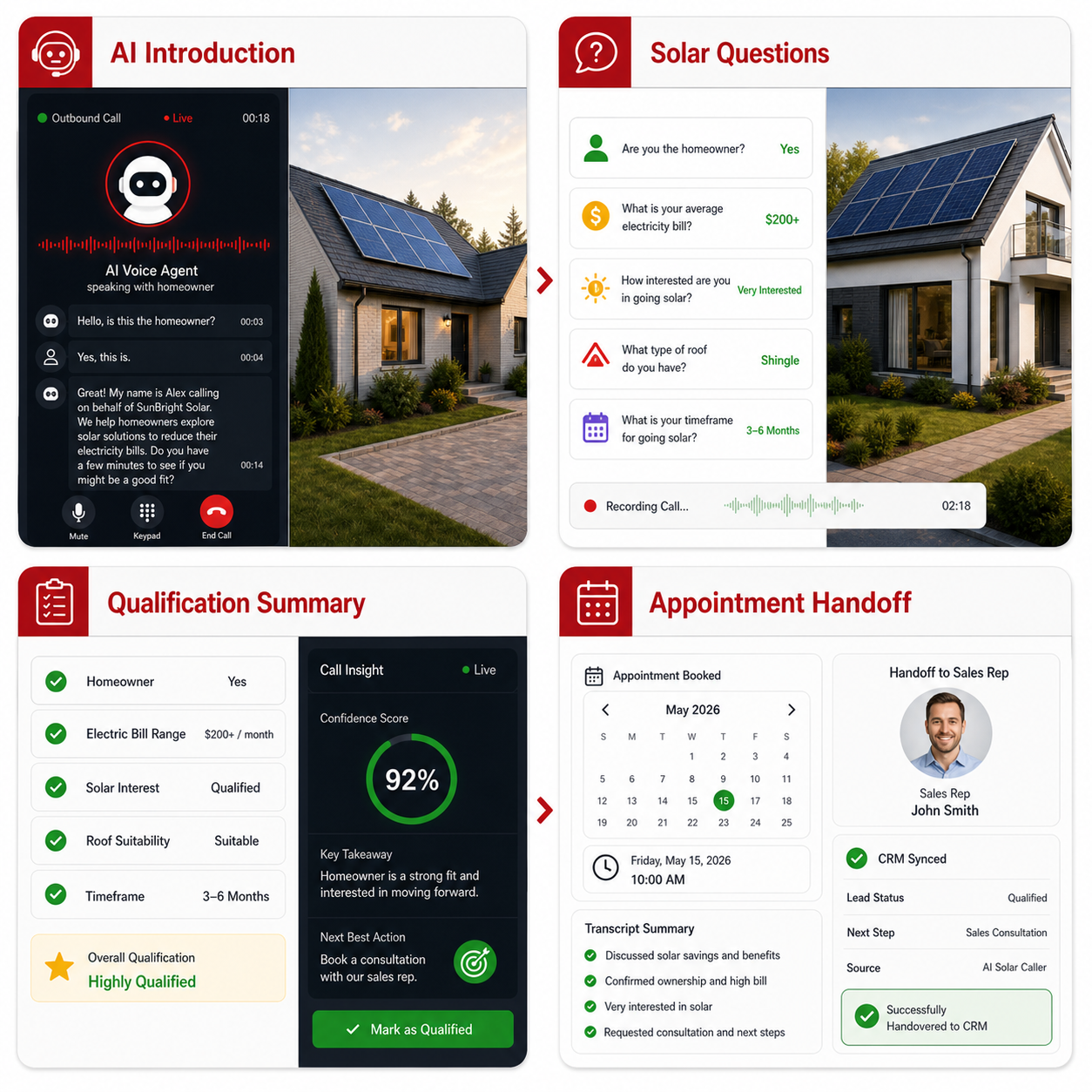
Conversation record
The important answers, objections, opt-out signals, and agreed next action stay together instead of being lost in an unstructured call note.
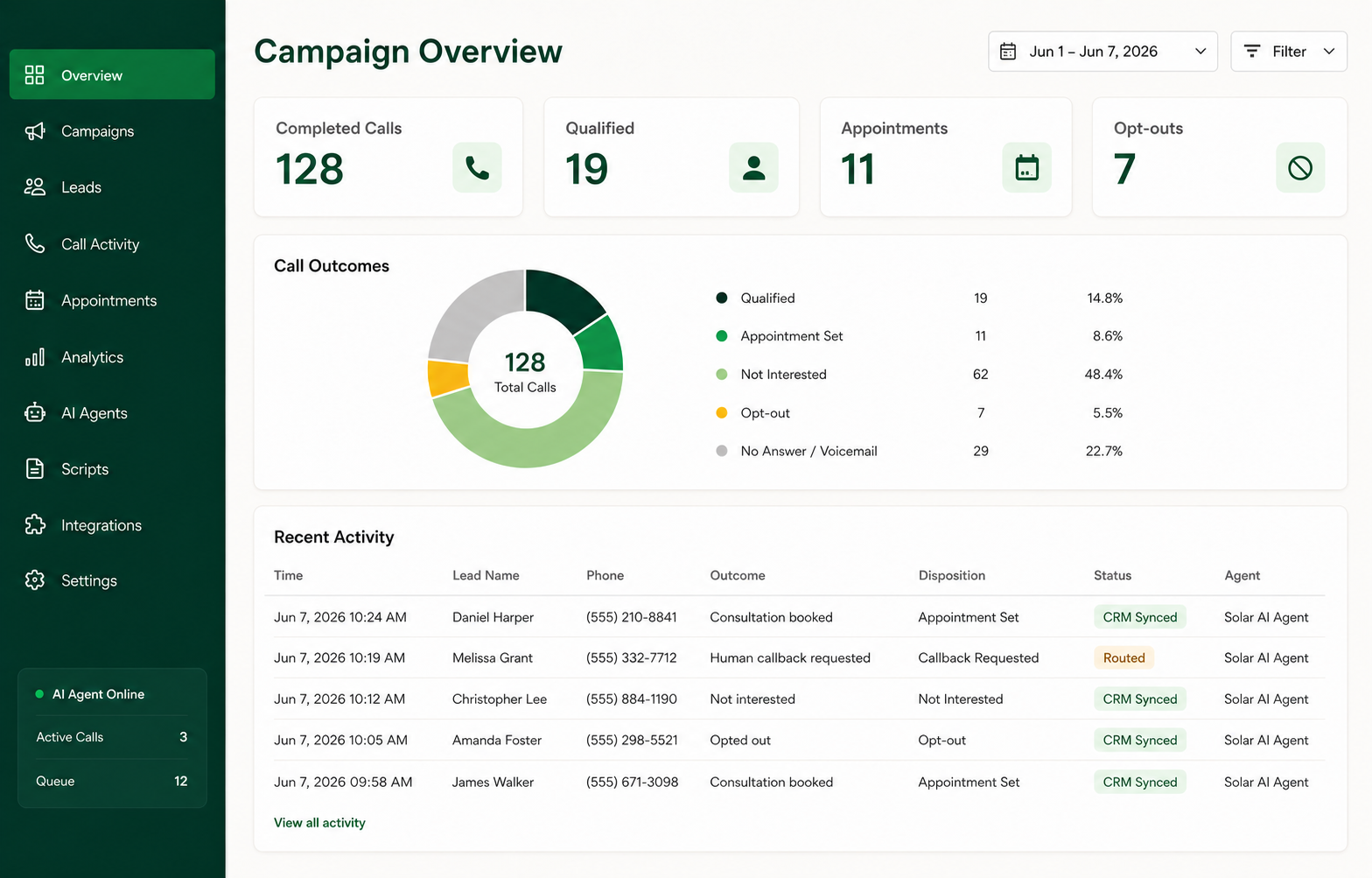
Campaign view
A campaign view makes activity, qualification, appointments, opt-outs, and follow-up gaps visible for review.
Example voice recordings
These recordings demonstrate how the workflow handles introduction, qualification, an objection, property-detail confirmation, and appointment booking before a person takes the next step.
Scenario introduction
The caller identifies itself, confirms the prospect, asks permission to continue, and starts basic solar qualification.
Scenario objection
The prospect raises a cost concern. The caller acknowledges it, explains the low-commitment next step, and respects the preferred follow-up.
Scenario address confirmation
The caller reads back the installation address, captures a correction, and confirms the property before continuing.
Scenario booking confirmation
The prospect chooses a time and call format. The caller repeats the details and confirms the next action.
Demo voices are synthetic and the names, addresses, and campaign details are fictional.
The practical difference
The value is not simply having a first conversation. It is giving the next person enough context to make a good decision without replaying the whole interaction.
The important answers and concerns are easy to find.
The record says what was agreed, not just that a call happened.
A salesperson can apply judgement before the relationship moves forward.
What to carry forward
Use the pattern as a starting point. Choose one workflow, one owner, and one measure that will tell you whether the change is worth keeping.
Context and limits
Remova Tech delivery example based on a practical lead-operations workflow. No client-identifying information or unsupported performance claim is published here.
Have a similar workflow?
Bring the repeated work, uncertain handoff, or daily bottleneck. We will help you decide what to improve and how to keep a person accountable for the result.