Renewable Energy Guide
AI Knowledge Bases for Renewable Energy: Answers from Your Manuals
Your service team may already have the answer a customer needs. The difficulty is finding it in the right manual, checking that it applies to the equipment in front of them, and explaining it clearly.
An AI knowledge base for renewable energy can make approved documents easier to search and use. Staff ask a question in ordinary language, and the application retrieves relevant material, prepares an answer, and shows where the information came from.
The value depends on the quality of that connection. A fluent answer from the wrong equipment revision can create more work than a search that returns nothing. Start with a defined document collection, specific users, and questions the system can answer responsibly.

Choose a narrow first collection
Pick a group of documents with a clear owner and recurring demand. That could be distributor support material for one product family, approved warranty documents, or the administrative guidance used by a maintenance planning team.
A small collection makes it easier to establish which source should take priority when documents disagree. It also gives users a realistic understanding of what the assistant covers.
For every document, record:
- The equipment family or business process it applies to.
- Its revision, approval status, and effective date where relevant.
- Who owns it and who may access it.
- Whether it replaces another document.
- Where the authoritative original is stored.
If nobody can decide which version is current, resolve that issue before treating the documents as an answer source. Uploading more files will not settle the disagreement.
Connect each answer to usable evidence
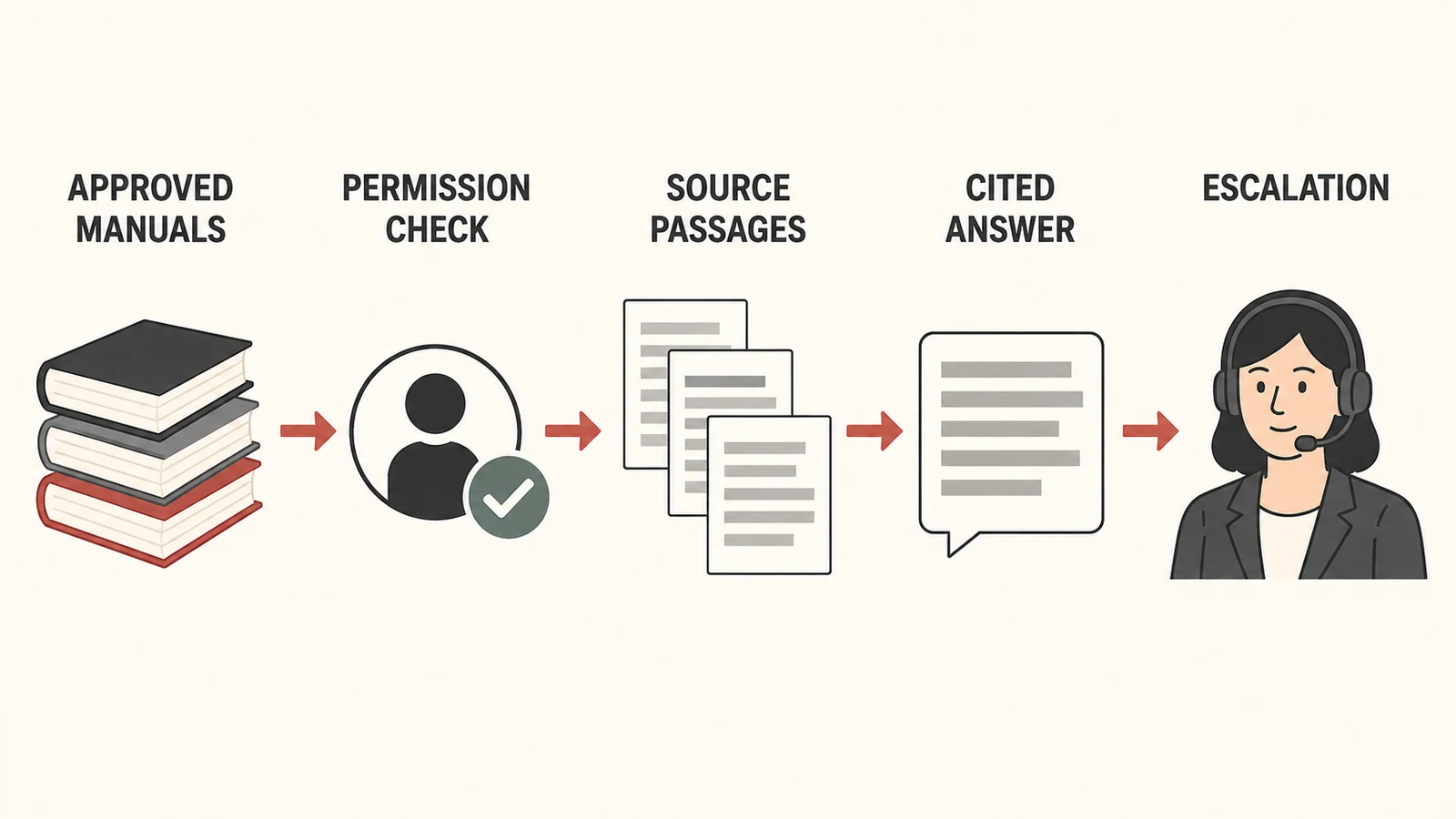
A retrieval-based assistant searches a document collection for relevant passages before preparing its response. The user should be able to open the cited material and check the section that supports the answer.
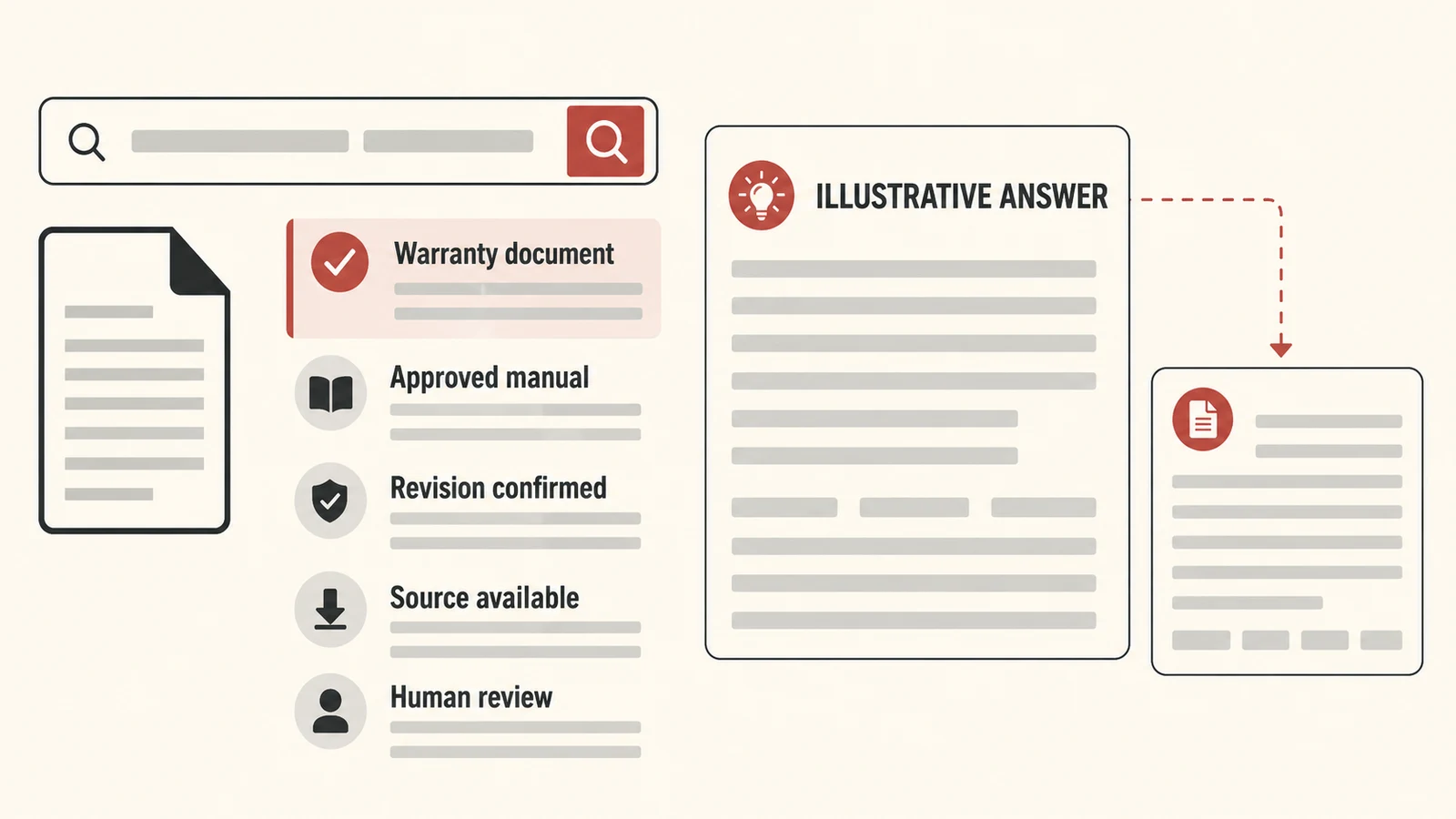
Consider an illustrative warranty query: “Which document describes the information required for a claim on this product?” A useful answer identifies the applicable approved document and points to the relevant section. If the product revision is missing, it asks for that information or presents the ambiguity.
Check citations for meaning as well as presence. A link to a long PDF is less helpful than a reference to the specific section. A cited passage must support the statement beside it; the existence of a citation does not establish that the answer is correct.
Design the interface so uncertainty is visible at the moment the answer is used. “Two applicable revisions were found” gives the user a reason to pause and a route to resolve the issue.
Treat permissions as part of retrieval
Define access at the source and enforce it before information reaches the answering step. Someone permitted to read a public installation guide may not be permitted to read internal service notes or a customer's project documents.
The same rules should apply to retrieved passages, answer summaries, attachments, and conversation history. An answer should not reveal the contents of a restricted document merely because the underlying search service can access it.
Test permission changes as well as initial setup. If a contractor leaves a project, can they still retrieve its information through an old conversation? If a document is withdrawn, does a cached answer remain available without a warning?
For broader support processes around the assistant, our AI customer service automation guide covers routing and human handoffs.
Keep document changes visible
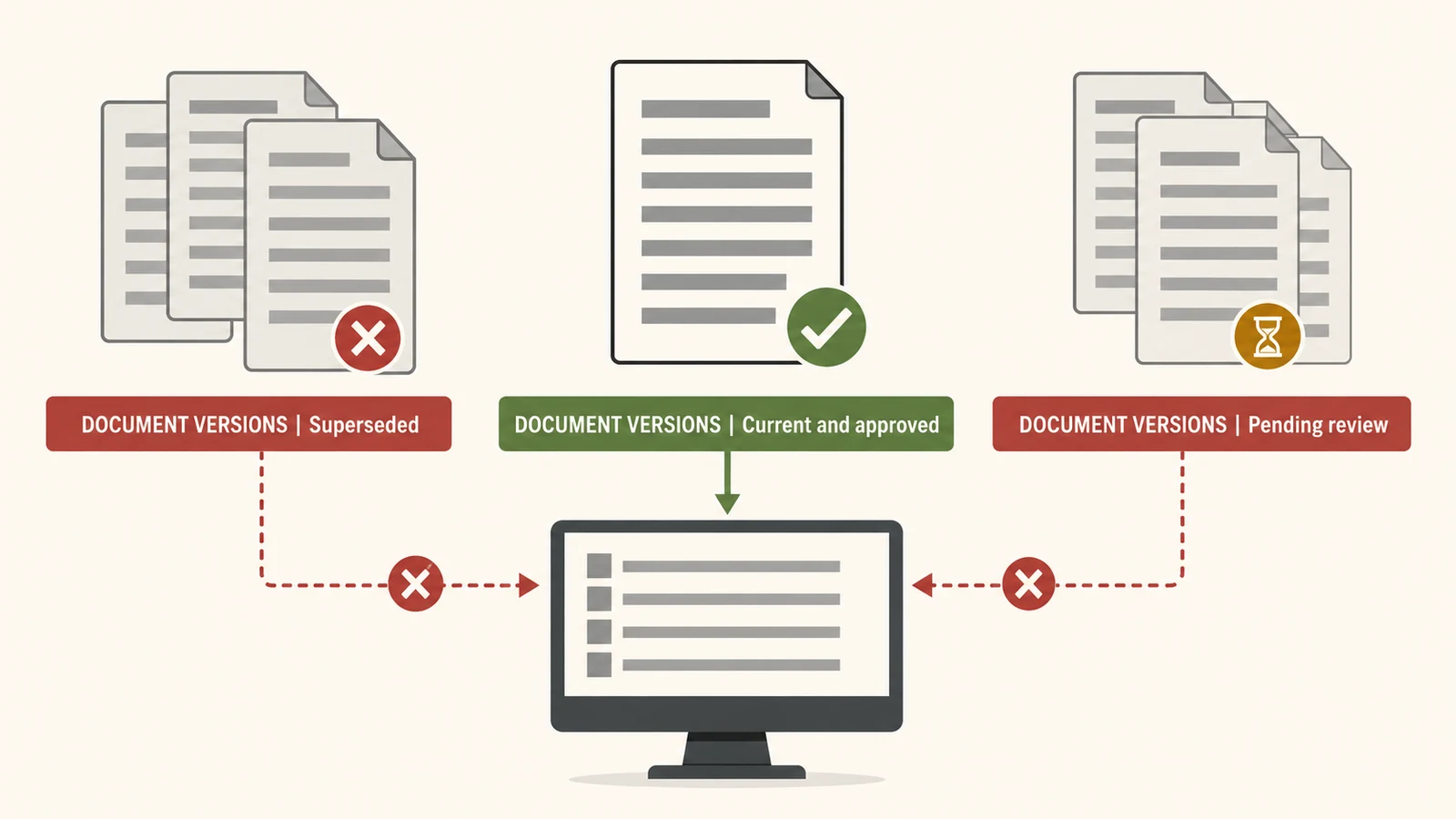
Give the knowledge base a maintained document lifecycle: received, under review, approved, superseded, and withdrawn. Define how quickly each change reaches the searchable collection and how the team confirms it happened.
Keep historical material available where required, but avoid presenting it as the ordinary current answer source. A user deliberately researching an older equipment revision should see the revision clearly throughout the exchange.
When a document changes, rerun questions affected by that change. An assistant that answered correctly last month may now retrieve a passage that has been replaced.
This is one reason the document owner and application owner need an ongoing relationship. Updating the source library and maintaining the answering system are connected responsibilities.
Plan multilingual support around the source
An assistant can help users ask questions in one language and find information in another, but translated terminology needs testing. Equipment codes, part identifiers, units, and revision references must retain their meaning.
Keep the source passage accessible alongside the translated explanation. Ask qualified reviewers to check representative questions in the languages your customers or staff actually use.
Renewable-energy companies are already exploring this service model. AWS describes Deye using an AI-enabled customer-service system across multiple communication channels. It is a vendor-reported example of implementation, not a measure of how accurately a different document collection will answer your team's questions. AWS Deye case study.
Define when the assistant hands over
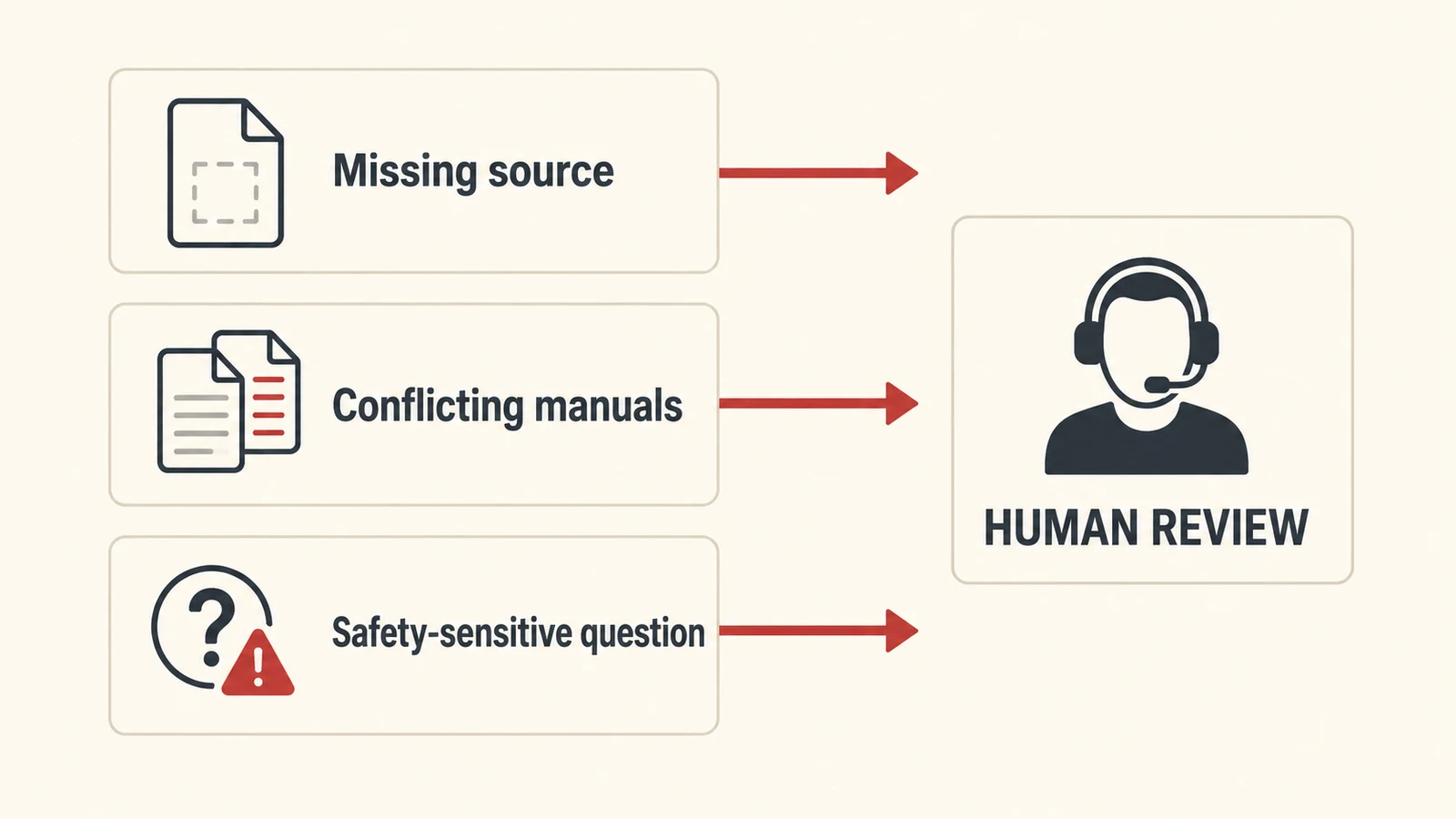
Set a clear response for missing evidence, conflicting instructions, unidentified equipment, and questions outside the approved scope. The user should know what information is missing and how to reach the right person.
Safety-sensitive equipment questions need an escalation route appropriate to your operating procedures. The assistant should not improvise instructions from fragments of unrelated manuals.
A handoff should preserve the question, equipment context, sources searched, and the reason it could not produce an approved answer. That saves the specialist from restarting the investigation.
Evaluate answers before expanding access
Build a question set from real support needs, then add deliberate difficult cases. Include questions with no answer in the collection, similar product names, older revisions, and users who lack permission to see the relevant source.
| Evaluation area | What to check |
|---|---|
| Answer correctness | Does the response match the approved source? |
| Source support | Does each citation support the associated statement? |
| Equipment fit | Is the document applicable to the identified product and revision? |
| Access control | Is the user permitted to see all information returned? |
| Escalation | Does the system recognise questions it cannot resolve? |
Record errors by their consequences, not just their frequency. A missing convenience link and a wrong equipment instruction should not carry the same weight. Repeat the relevant checks when the model, retrieval process, or document collection changes.
NIST's voluntary AI Risk Management Framework provides a broader basis for evaluating and managing AI risks throughout a system's use. Apply that thinking to the actual questions and decisions your assistant supports. NIST AI Risk Management Framework.
Common questions
Can we start with PDFs?
Yes, but inspect whether the text, tables, and page references can be extracted reliably. Scanned pages and complicated layouts may need preparation before they work well as retrieval sources.
Will the assistant always find an answer?
It should be able to say when the approved collection does not establish an answer. That is an essential part of a useful technical support tool.
Who should maintain it?
Assign an owner for approved content and an owner for the application. They need a shared process for updates, quality checks, access changes, and user feedback.
Make your approved knowledge easier to use
Remova Tech builds AI applications for renewable-energy teams, including document and support workflows. Bring a sample of your approved manuals and recurring questions, and we can help define a useful first collection.