Renewable Energy Guide
AI Solar Lead Qualification: What to Ask Before a Site Visit
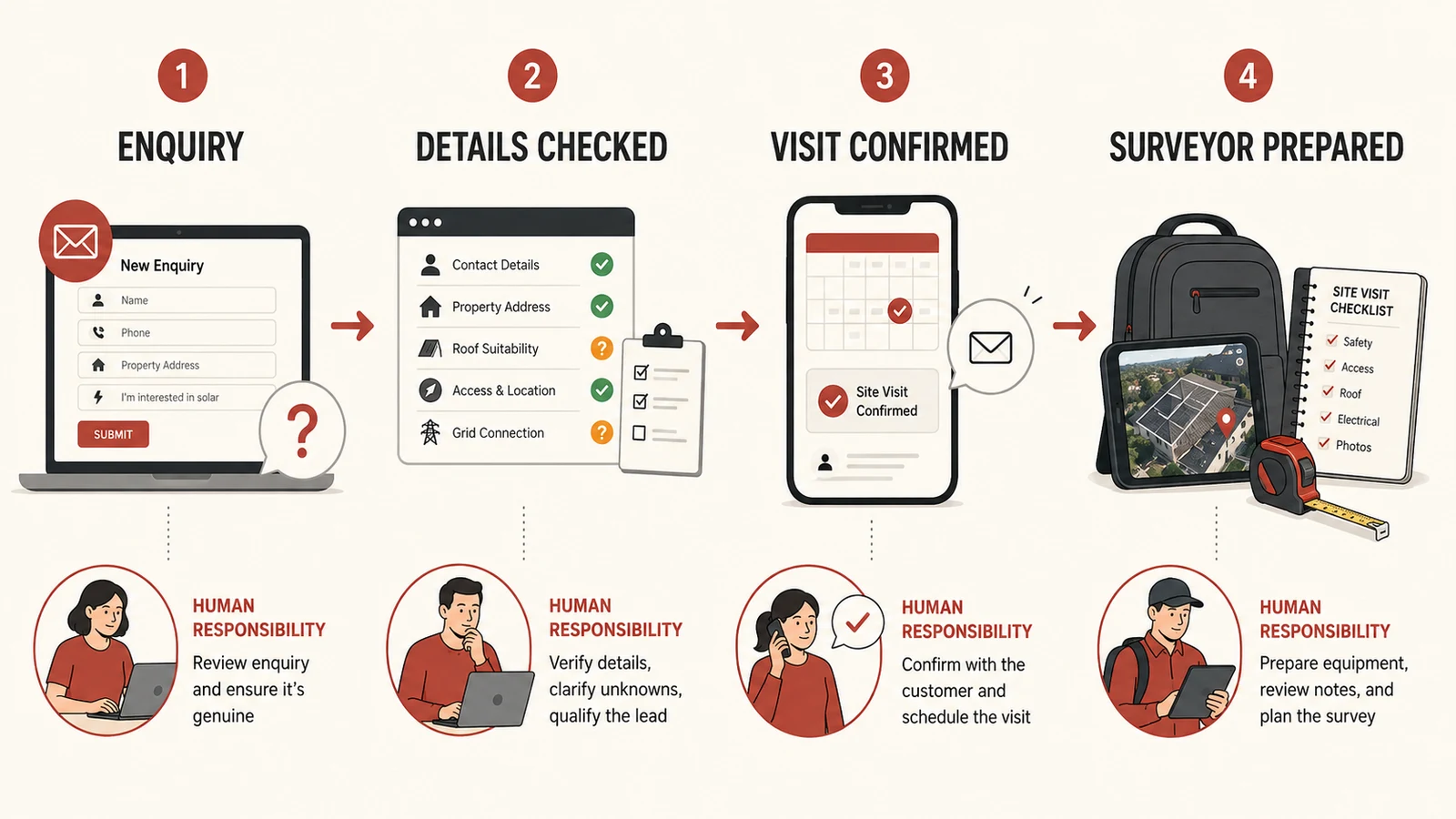
A survey appointment is more useful when the person attending knows why the customer is interested, what information is available, and which questions remain open. When those details are missing, the surveyor becomes the next person to repeat the same intake conversation.
AI solar lead qualification can help collect project information, identify gaps, and prepare a clear handoff. The aim is to give your sales and survey teams a better starting point while keeping uncertain answers visible.
A useful qualification process separates three questions: Is the enquiry within your service scope? Is there enough information for the next conversation? What technical questions still require a qualified assessment?

Define a useful enquiry for your business
Different installers need different information. A team handling commercial rooftops may need to understand site ownership, several buildings, and the customer's decision process. A residential team may start with a simpler property and consumption discussion.
Write a short definition of “ready for a survey” with the people who conduct the visits. Include only information they use to prepare or decide the next step.
For example, a fictional residential team might require a confirmed address, an appropriate site contact, a stated project objective, and either consumption information or a clear note that it remains outstanding. A roof assessment can remain a separate technical task.
Avoid treating every missing answer as a rejection. A customer who cannot find a bill today may still be ready for a useful conversation.
Ask questions that lead to an action
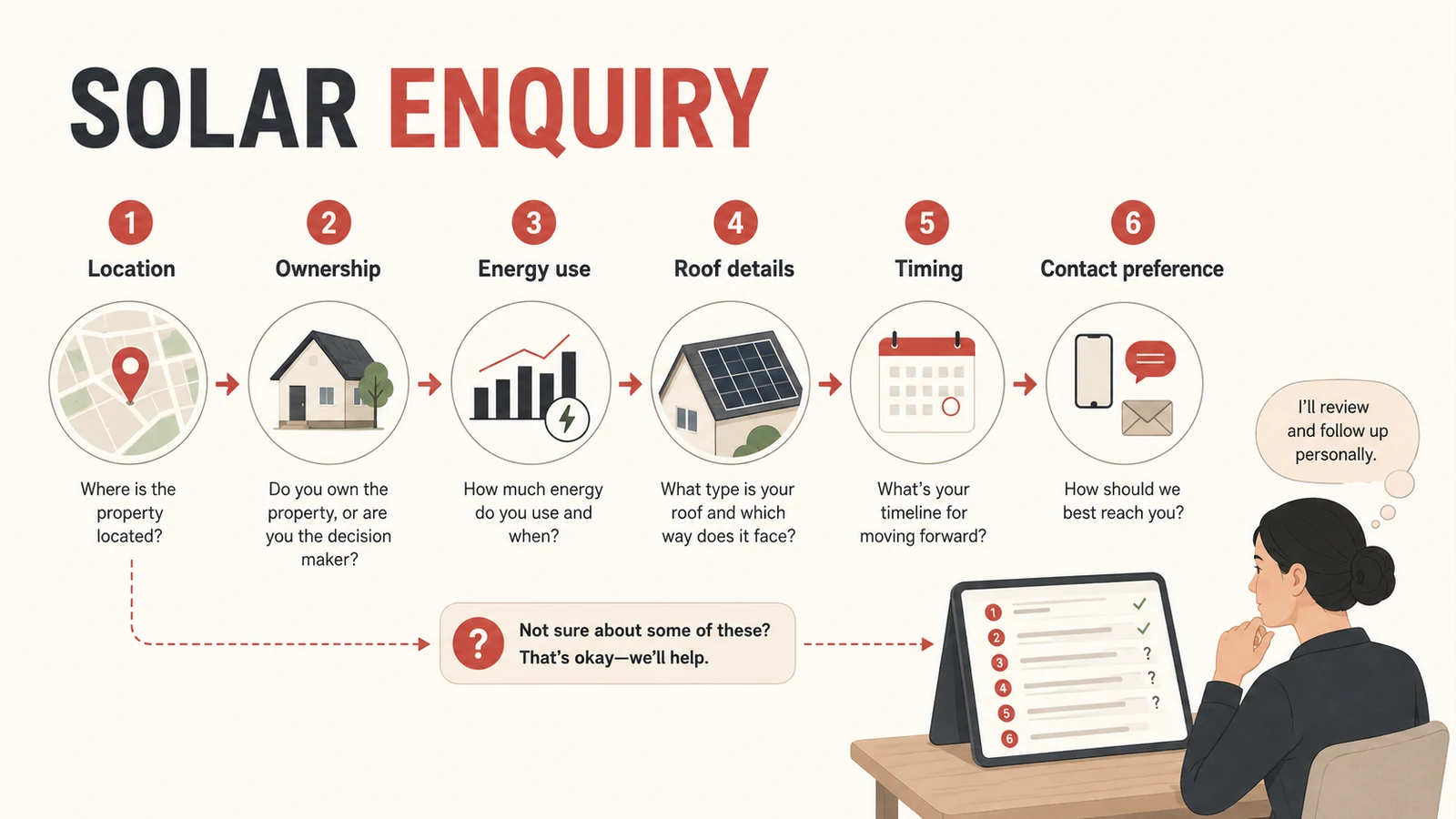
Each intake question should help your team do something: confirm coverage, prepare the survey, choose a specialist, or request a missing document.
| Question | How the answer helps |
|---|---|
| What is the installation address? | Confirms the site and whether it falls within your service area |
| Do you own the property or act for the owner? | Identifies the relevant decision-maker and any permission discussion |
| What are you hoping to improve? | Establishes the customer's objectives without assuming the solution |
| Do you have recent electricity usage information? | Shows what is available for a later assessment |
| Is there anything we should know about the roof or access? | Flags practical questions for the surveyor |
| Are you considering storage or another planned electrical change? | Identifies additional discussion points |
| What timing do you have in mind? | Helps prepare a realistic next conversation |
| How would you prefer us to contact you? | Supports a useful follow-up and records the stated preference |
Allow “I don't know” and free-text answers. Ask customers to clarify ambiguous information rather than forcing it into an inaccurate dropdown choice.
Keep requests proportionate to the stage of the enquiry. You rarely need every project document before confirming who should speak to the customer next.
Give AI a clear role in the conversation
An assistant can ask approved questions, summarise answers, and identify information that has not been supplied. It can also prepare a follow-up request for a person to review.
Define the statements it may make about your service area, appointment process, and available services. Keep those facts in an approved source that someone maintains.
For an illustrative example, a customer might say: “We recently moved in, so the old bills won't tell you how we use the building.” A useful summary preserves that point and tells the surveyor that historical consumption may not represent the planned use. It should not manufacture an annual usage estimate and present it as the customer's answer.
The same principle applies to timing. “We are exploring options” should remain exploratory, rather than becoming a purchase commitment in the CRM.
Route enquiries by the next useful step
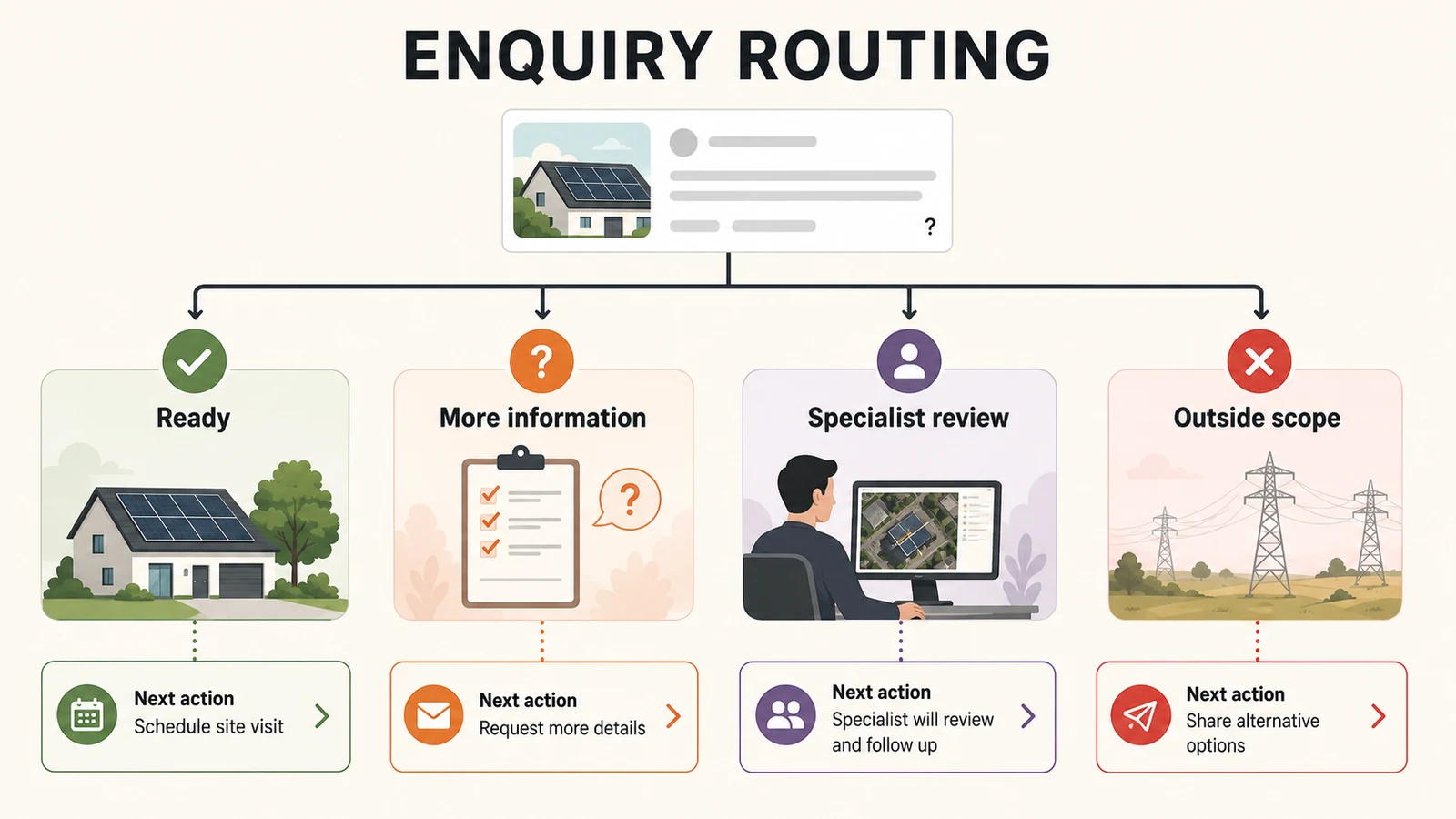
A single score can hide the reason an enquiry needs attention. Use clear states that your team can act on.
- Ready for the next conversation: The basic project details are available and the enquiry fits your service scope.
- More information requested: A specific document or answer is missing, with an owner for follow-up.
- Specialist review needed: The project has a technical, commercial, or ownership question that needs a person.
- Outside current scope: The enquiry falls outside your coverage or services, with an accurate explanation available to the team.
Review uncertain classifications before they cause a customer to be declined. Technical suitability should not be inferred from a short intake exchange, and commercial priority should be based on explicit business criteria rather than speculative personal characteristics.
For wider sales processes, see our guide to AI lead generation workflows.
Prepare a handoff the surveyor can use
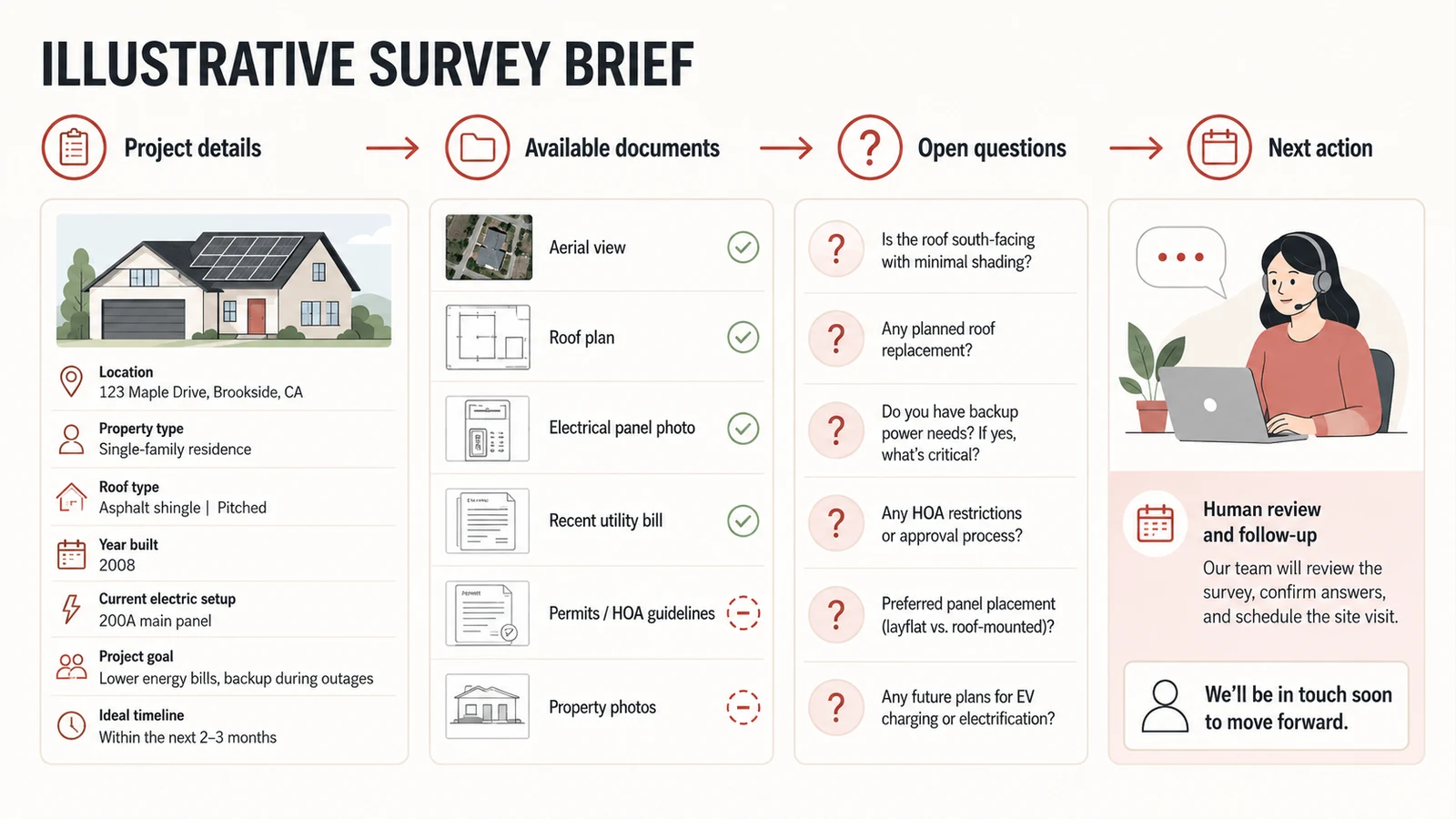
The output should be a concise project brief, not a transcript that someone must read from start to finish.
Include the confirmed address, customer objective, available documents, practical site notes, outstanding questions, and agreed next action. Retain the original answers so a colleague can check the summary when needed.
Keep the customer and project linked to a stable record. Where solar design software and the CRM need to exchange information, check the integration options already available. Aurora's CRM app documentation is one example of a provider supporting connections between customer systems and solar project workflows. Aurora CRM integration documentation.
Appointment booking needs its own checks. Confirm availability from the scheduling system, make changes visible to the team, and distinguish a requested time from a confirmed visit. Repeated submissions should update or flag the existing enquiry rather than silently create several appointments.
Test the enquiries that are hard to summarise
Use anonymised or synthetic examples covering incomplete addresses, contradictory answers, unusual roof notes, changed plans, and requests for a person. Include the languages your team actually supports.
Ask a sales colleague and a surveyor to review the resulting briefs independently. Could they prepare for the next conversation? Did the assistant preserve important uncertainty? Did it add anything the customer never said?
Measure missing-field rates, summary corrections, manual follow-up, and how often surveyors need to repeat intake questions. Track appointment outcomes separately; a complete record alone does not prove better sales performance.
Common questions
Does solar lead qualification require a voice agent?
No. The workflow can begin with a website form, email, chat, or a staff-led conversation. Choose the channel your customers use and make the information consistent across those channels.
Should every enquiry be scored?
A clear next-action status is often easier to use than an opaque score. If you use scoring, document the criteria and make the underlying answers visible to the team.
Can AI decide whether a roof is suitable?
An intake assistant can collect roof information and flag questions. Technical suitability depends on the assessment process and evidence your qualified team requires.
Give your team a better starting point
Remova Tech develops solar lead qualification workflows that connect useful questions, clear records, and human handoffs. Show us the information your survey team needs before a visit, and we can help shape the intake around it.