Renewable Energy Guide
AI for Wind Turbine Maintenance Reports: Make Field Notes Usable
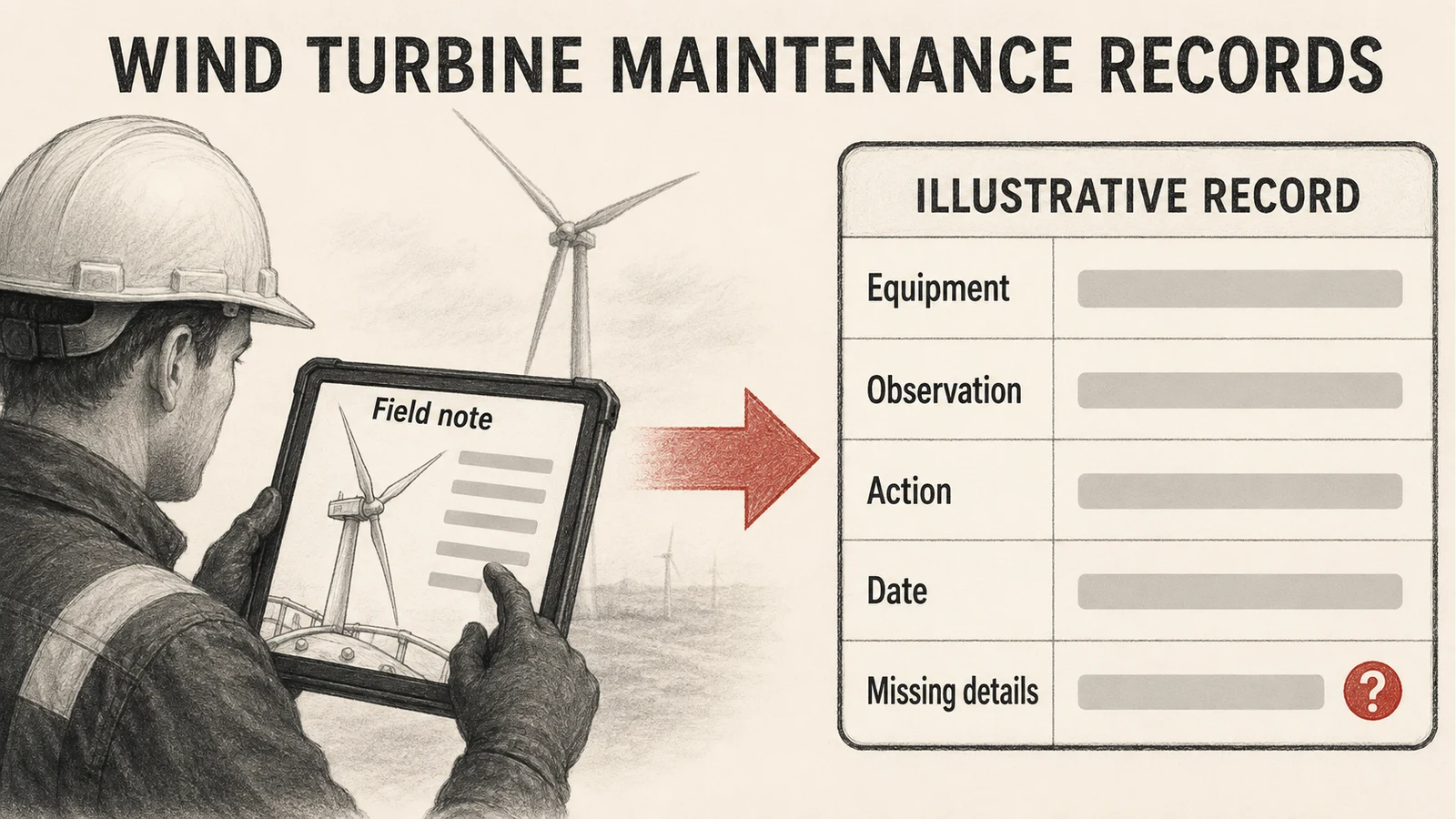
A technician's note may be clear to the person who wrote it and difficult for everyone else to reuse. Equipment names vary, abbreviations depend on the team, and a short account of completed work may omit the fields needed for a monthly report.
AI can help turn wind turbine maintenance notes into structured records. A focused application can identify equipment references, extract documented observations and actions, and highlight missing information for review.
The most useful first result is a record that remains connected to its source. Your team should be able to see what the technician wrote, what the application proposed, and what a reviewer confirmed.

Choose the reporting job before choosing the model
Start with the output your operations and maintenance team needs. Is the immediate problem preparing service summaries, classifying completed work, finding records for a component, or checking whether reports contain required information?
Each job needs different fields and review rules. A monthly service summary may need the work performed and outstanding actions. A reliability study may require a much more demanding interpretation of event history.
For an initial reporting workflow, consider these fields:
| Field | How to handle it |
|---|---|
| Site and turbine | Match against the asset register; flag unresolved references |
| Record date | Preserve the source date and distinguish it from processing time |
| Component | Use the agreed hierarchy when the note supports a match |
| Observation | Retain what was reported without adding a diagnosis |
| Action completed | Separate finished work from recommendations |
| Follow-up | Identify documented outstanding actions and missing details |
| Evidence | Link each extracted field to the original record |
Keep the first schema short enough for reviewers to use. More fields are worthwhile only when they improve a decision or reduce later work.
Separate extraction from interpretation
Consider this fictional note: “Turbine 14. Checked cooling unit after repeat alarm. Filter replaced. Retest arranged.”
An extraction workflow can record the asset reference, the reported alarm context, the filter replacement, and the planned retest. The note does not establish a confirmed root cause, a successful retest, or a return-to-service decision.
Those gaps should remain visible. If the application proposes a component classification, it should show the source words and let the reviewer confirm the match.
Avoid turning “possible,” “suspected,” or “to be checked” into definitive statements. Preserve uncertainty and distinguish a technician's observation from an analytical suggestion.
This boundary matters because a tidy structured record can look more authoritative than the incomplete note it came from.
Match notes to the correct equipment
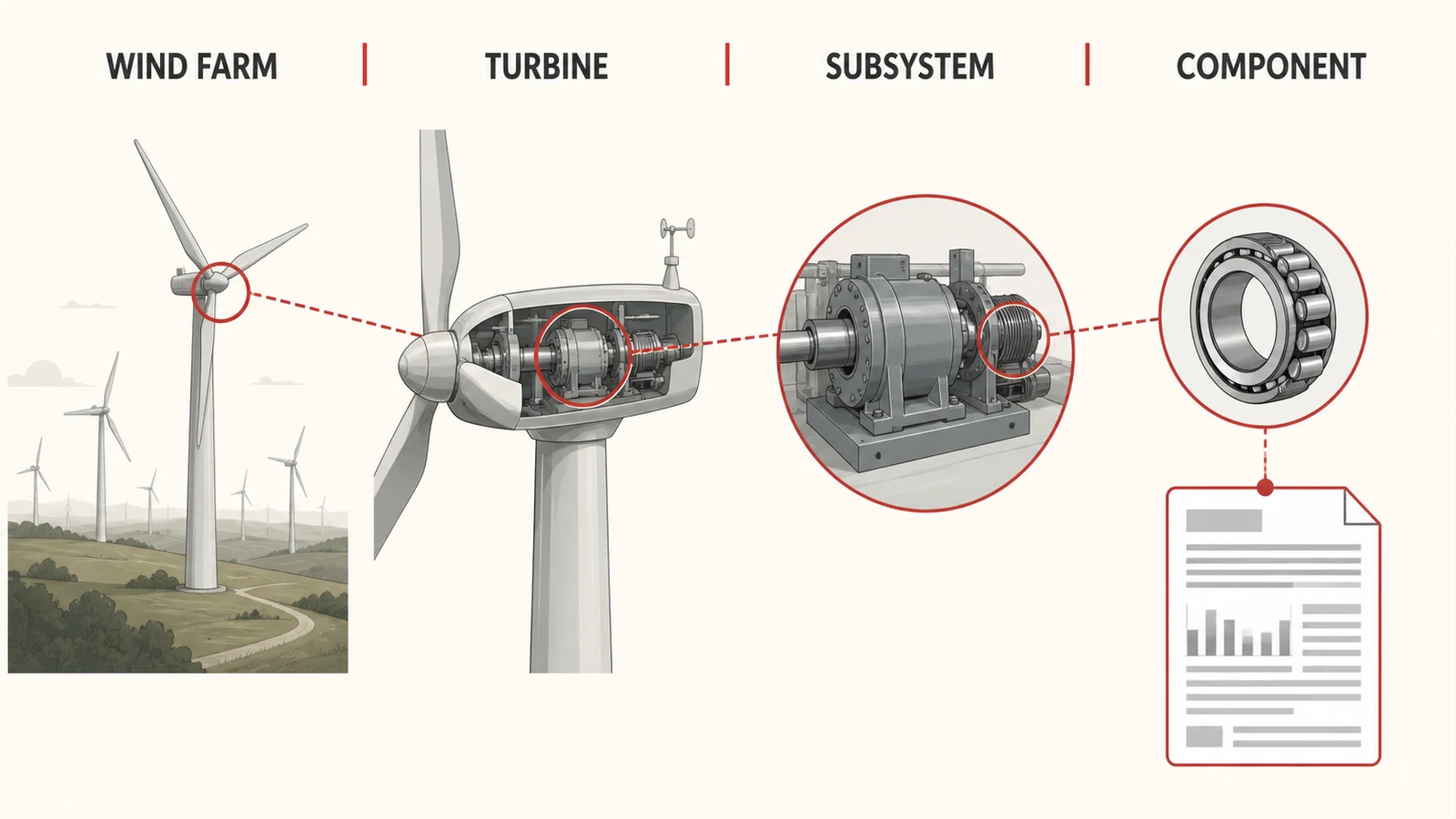
Establish a maintained hierarchy from site to turbine, subsystem, and component. Record the local names and abbreviations your team uses, but keep them connected to the canonical asset reference.
A note that mentions “unit 2” may be obvious in one work order and ambiguous in an exported spreadsheet. Use surrounding authorised record context where it is available. If the context does not establish the match, send it for review.
Keep mapping corrections traceable. When a reviewer changes a component assignment, record the correction and its reason. Over time, those examples can improve your terminology dictionary and evaluation set.
Our intelligent document processing guide covers the wider process of extracting useful information from operational documents.
Use research to define a testable scope
Recent research has investigated language-model workflows for reviewing and structuring historical wind maintenance logs. The Wind Turbine Maintenance Log Labelling Framework, revised in August 2026, describes structured extraction, record-level provenance, exclusions, and review routes. Its outputs are presented as candidate evidence for further analysis. Wind Turbine Maintenance Log Labelling Framework.
That supports testing a bounded data-preparation task. It does not establish that an application trained or configured on a different fleet can diagnose failures reliably.
When evaluating a supplier, ask them to demonstrate the distinction using your sample records. They should be able to show where the proposed system extracts a fact, where it classifies a record, and where it would need additional evidence.
Build a review queue that saves effort
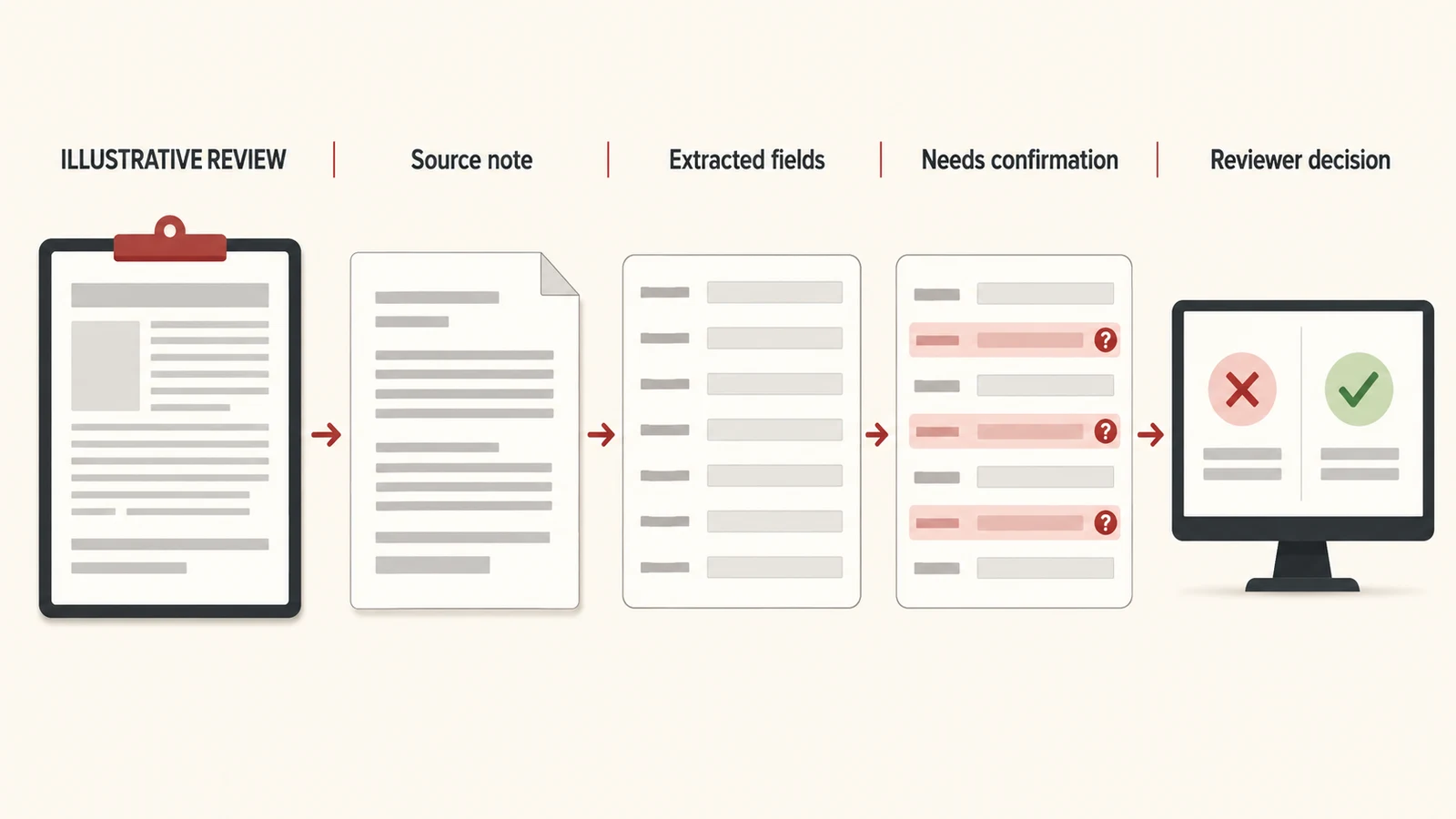
Show the original note beside the extracted fields. Highlight the exact passage supporting each field and make uncertain or missing items easy to find.
Prioritise records that could affect reporting or follow-up: unclear asset references, contradictory dates, proposed root causes, or a mismatch between completed and planned work. A low-confidence label alone is not enough to explain why a record needs attention.
Agree on which low-risk records may be accepted after the workflow has been tested and which always require a person. Review samples from accepted records as well as the exception queue, so apparently easy cases do not escape quality checks.
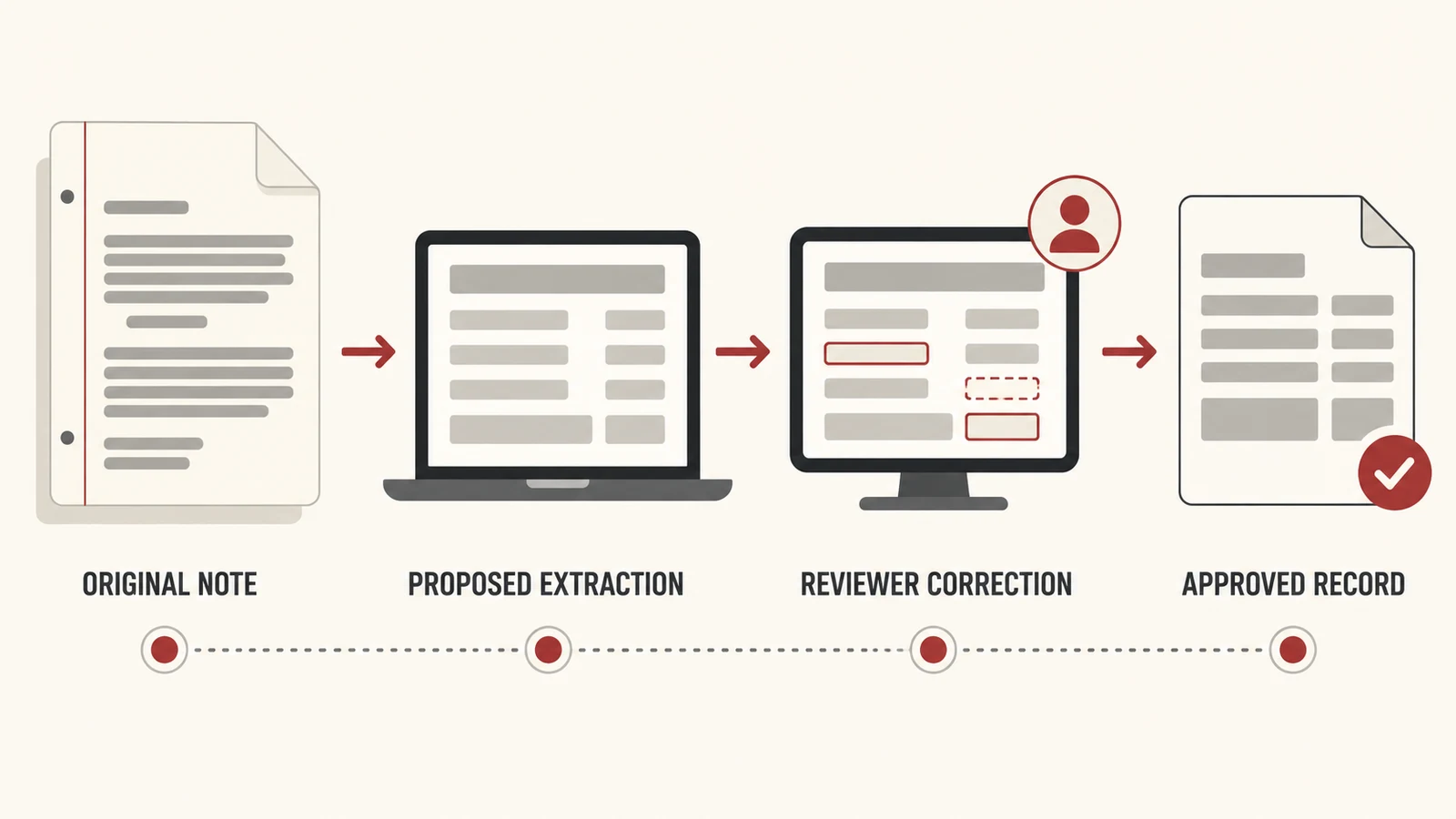
Maintain four distinct items in the record history: the original note, the proposed extraction, any reviewer changes, and the approved version.
Connect approved records to the maintenance system
Begin with a reviewed export if that is the simplest way to prove the value. Before enabling direct writes to a maintenance management system, agree on field ownership, update permissions, and duplicate handling.
If the original work order changes, the structured record should show that a new source version exists. Retrying a failed transfer should not create a second maintenance event.
Treat report preparation and operational execution as separate scopes. An application that summarises a completed visit does not automatically need permission to close work orders, schedule interventions, or change equipment settings.
Test across the way your fleet actually writes
Build a sample covering different sites, technicians, languages, note lengths, and time periods. Include incomplete records, duplicate exports, unusual abbreviations, and notes that contain no relevant maintenance information.
Have qualified reviewers establish the expected fields for an evaluation set. Measure asset-match accuracy, extraction errors, missed follow-up items, reviewer correction time, and unsupported statements. Keep performance by record type visible so a strong result on simple notes does not hide weak results elsewhere.
Compare the complete review effort with your current process. Faster initial extraction is useful only if the correction burden remains manageable.
Common questions
Can old maintenance logs be used?
Yes, historical records can be a useful starting collection. Expect older terminology, changed asset references, and incomplete context to require preparation and review.
Does this require predictive maintenance?
No. Structuring and checking maintenance records is a distinct application. It can improve access to information without making predictions about future failures.
Can technicians keep writing in ordinary language?
A workflow can accept free text, but a few agreed required fields may still improve the source records. Test the balance with technicians so the reporting process does not make field work harder.
Turn field records into useful reporting inputs
Remova Tech builds document and operational AI applications around real workflows. Start with a sample of anonymised maintenance notes and the report your team needs, and we can help define the extraction, review, and integration steps.