Australia’s Record Renewable Quarter: Why Battery Dispatch Software Matters
Australia’s latest market data shows what happens after solar growth becomes normal: batteries, networks, forecasting, and customer devices have to work as one system.
Focus
Australia’s renewable grid
Written for
Utilities, battery developers, virtual power plant operators, energy retailers, and grid technology teams
Editorial standard
Facts, status, and practical implications
At a glance
- AEMO reported that renewables supplied 46.5% of National Electricity Market generation in Q1 2026.
- Grid-scale solar generation averaged 2,706 MW, up 13% year on year in the quarter.
- AEMO’s 2026 ISP continues to emphasise renewables connected by networks and firmed with storage.
A record share creates a different kind of problem
The Australian Energy Market Operator reported that renewables supplied 46.5% of generation in the National Electricity Market during the first quarter of 2026, the highest first-quarter share on record. AEMO also reported growth in grid-scale solar and a larger role for batteries. Those numbers are encouraging, but they do not mean the system has reached a comfortable finish line. A high renewable share changes the timing of risk as much as it changes the total mix.
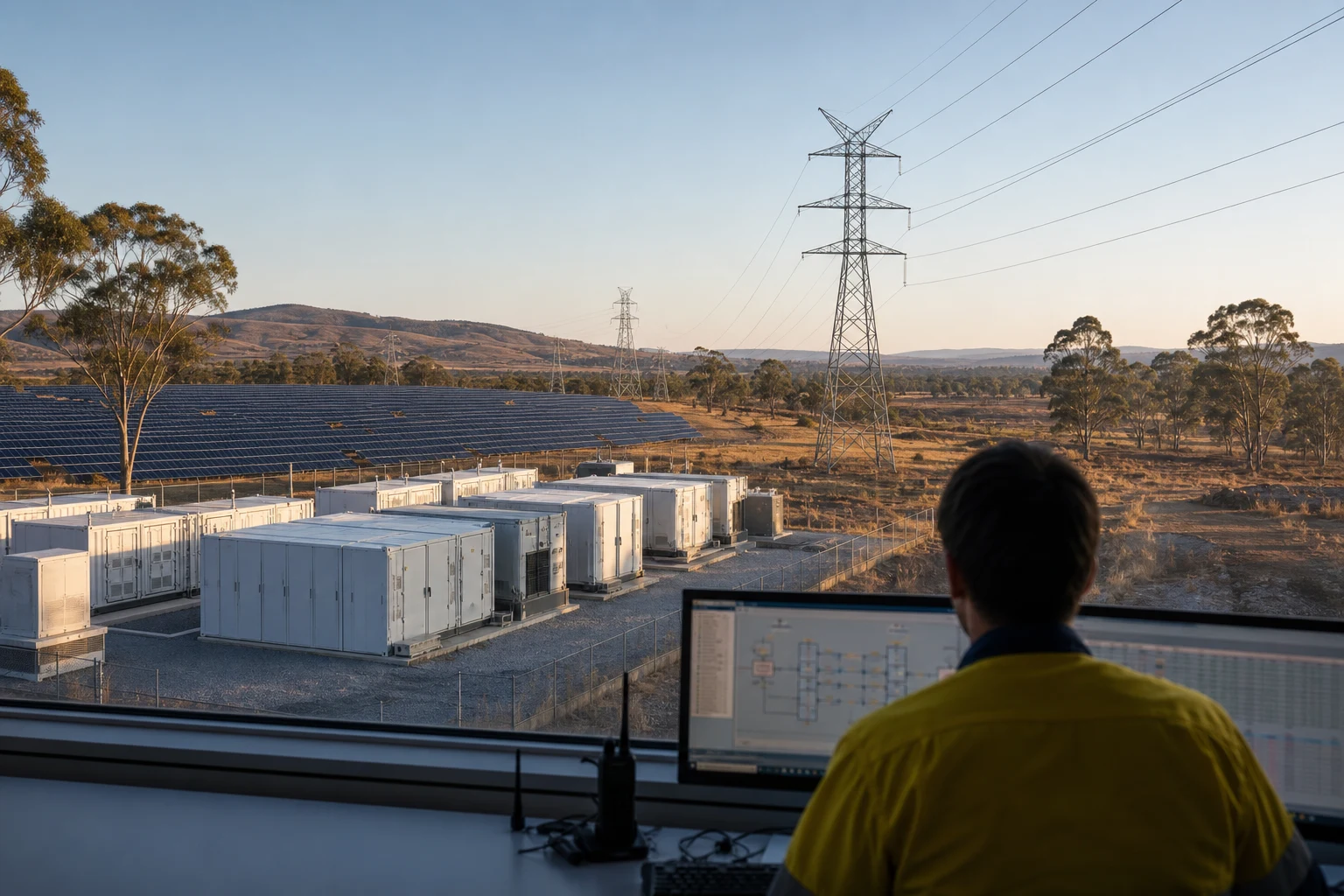
When rooftop and utility-scale solar are producing strongly, the challenge can be a midday surplus. Later, as the sun drops and demand remains, the system needs fast, dependable supply. Batteries can bridge that gap, but only if they have energy available, a connection that can respond, and an operating strategy that understands both the market and the physical network.
Batteries are becoming an operating layer
A battery is not simply a box that fills during the day and empties at night. It can respond to price, frequency, congestion, reserve requirements, local network needs, and a customer’s own load. Those objectives can conflict. A dispatch decision that looks attractive in a price signal may leave the battery less prepared for a sudden event. A system that follows a central instruction may miss what is happening at the edge of the network.
That is why battery software is becoming as important as battery hardware. Operators need a forecast, a set of constraints, a decision rule, and a record of what happened. AI can help by learning from historical behaviour and identifying when the current situation differs from the normal pattern. It should not hide the constraints. A battery manager should be able to see why a schedule changed and who can approve an override.
AEMO’s long view is about coordination
AEMO’s 2026 Integrated System Plan describes renewable energy connected through transmission and distribution, firmed with storage and backed up by gas, as the least-cost path under current settings through 2050. The sentence is less a prediction about one project than a planning model. It assumes that generation, storage, network investment, and backup capability are designed together rather than treated as unrelated markets.
That model creates work for data teams. Planning assumptions need to be updated as customer batteries, electric vehicles, weather, and project connections change. An operations team needs a way to compare the plan with actual behaviour. A forecasting system that never learns from its errors becomes a dashboard, not a decision tool.
The customer side is part of the grid
Australia’s transition also depends on consumer energy resources: rooftop solar, home batteries, electric vehicles, and flexible loads. These assets are smaller than a utility project, but collectively they can change the shape of demand. The commercial question is how to coordinate them without making customers feel that their equipment has become someone else’s remote-control experiment.
A trustworthy virtual power plant needs clear consent, understandable settings, and a way to show the benefit and the limits of participation. Automation can forecast the aggregated response and prepare dispatch instructions, but the service still needs good customer communication. Reliability is not only a technical metric; it is also a promise that the system will behave as described.
What energy teams should watch
The next useful signals will be less dramatic than a record percentage. Watch how battery projects move through connection and commissioning, how grid-forming capability is valued, how retailers use customer batteries, and how forecasts perform during unusual weather. Those details show whether the market can turn more renewable generation into dependable service rather than simply reporting a larger installed fleet.
Australia is a good global case study because it is already living the operational questions many other markets are approaching. The lesson is straightforward: solar growth is only half the work. The other half is the software, network discipline, and human trust that let batteries and flexible demand respond when the system needs them.
That operating layer also needs a calm response to failure. Forecasts will be wrong, devices will disconnect, and communications will drop during exactly the moments when confidence is lowest. Teams should rehearse the fallback: who makes the decision, which data is trusted, and how the system returns to normal after the event. Resilience is built in those details, not in a headline about capacity.
Sources and status
This is news analysis, not legal or financial advice. Proposals, forecasts, draft standards, and company statements can change. Check the linked primary sources and the publication date before relying on a detail.
From news to useful action
Need to make an energy workflow easier to run?
Remova Tech helps teams review opportunities, connect reliable data, and introduce automation with clear ownership and human control.