Renewable Energy Guide
Battery Storage Feasibility Software: Inputs and Scenarios to Check
A battery feasibility result is only useful when the project team understands what produced it. A recommended system size or attractive savings estimate can change when the load profile, electricity tariff, equipment constraints, or project objective changes.
Battery storage feasibility software helps teams explore those relationships before committing to a design. Selecting a tool means checking which decisions it supports, which assumptions it exposes, and how its results will be reviewed.
For a commercial site considering behind-the-meter storage, begin with a clear question. Are you investigating electricity-cost reduction, better use of on-site generation, support for critical loads, or a combination of objectives? A model configured for one purpose may not answer another.

Define what the assessment must decide
Write down the decision you want to make at this stage. It might be whether a site deserves detailed investigation, which options to compare, or what additional information is needed before approaching suppliers.
Separate early screening from detailed engineering and procurement. A screening model can help narrow options while leaving connection requirements, equipment selection, site constraints, and contractual details for further assessment.
Also define the scope of the tool. A commercial facility assessment and a front-of-meter trading project involve different questions. Do not assume a tool covers every operating arrangement simply because it can model a battery.
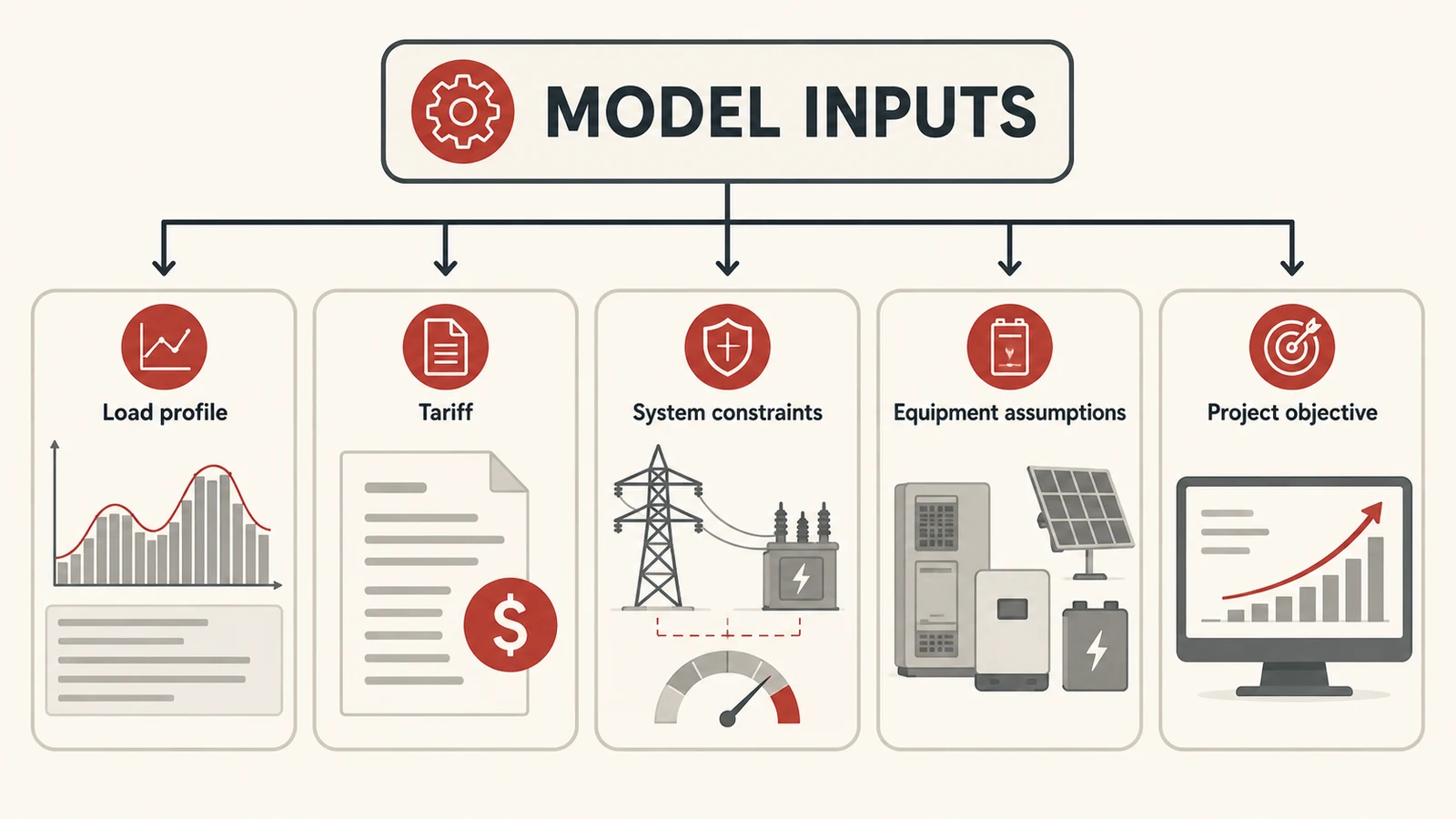
Collect inputs with an identifiable source
Use a checklist that records the origin, date, and owner of each material assumption.
| Input | What to check |
|---|---|
| Electricity load | Interval length, time zone, missing periods, and whether past use represents the planned site |
| Tariff | Applicable charges, timing rules, export treatment, and effective period |
| Existing generation | Data source, time alignment, and expected changes |
| Battery assumptions | Power, energy capacity, operating limits, efficiency, and supporting specifications |
| Project costs | Scope included, currency, quotation date, and exclusions |
| Project objective | The priority the model is being asked to pursue |
Keep measured inputs, supplier information, and planning assumptions visibly distinct. If the site is expanding, historical electricity use may not describe the load the battery will serve.
Resolve gaps deliberately. A missing interval should not silently become zero consumption, and an unknown cost should not appear to be a confirmed supplier price.
Understand the calculation behind the interface
Ask what method produces the recommended size and operating schedule. A clear explanation should connect the objective, constraints, and inputs to the output.
REopt is one example of a tool using mathematical optimisation to assess energy-system options. Its official introduction describes sizing and dispatch decisions using site information such as load and utility rate, with configurable assumptions. This is a calculation and optimisation approach, distinct from a language model writing a response. What is REopt?.
For an integrated application, AI could help prepare a structured draft of information from project documents. The calculation engine should still receive checked inputs, and the resulting numbers should retain a traceable connection to those inputs.
A polished explanation cannot substitute for a reproducible model run.
Compare a baseline with meaningful alternatives
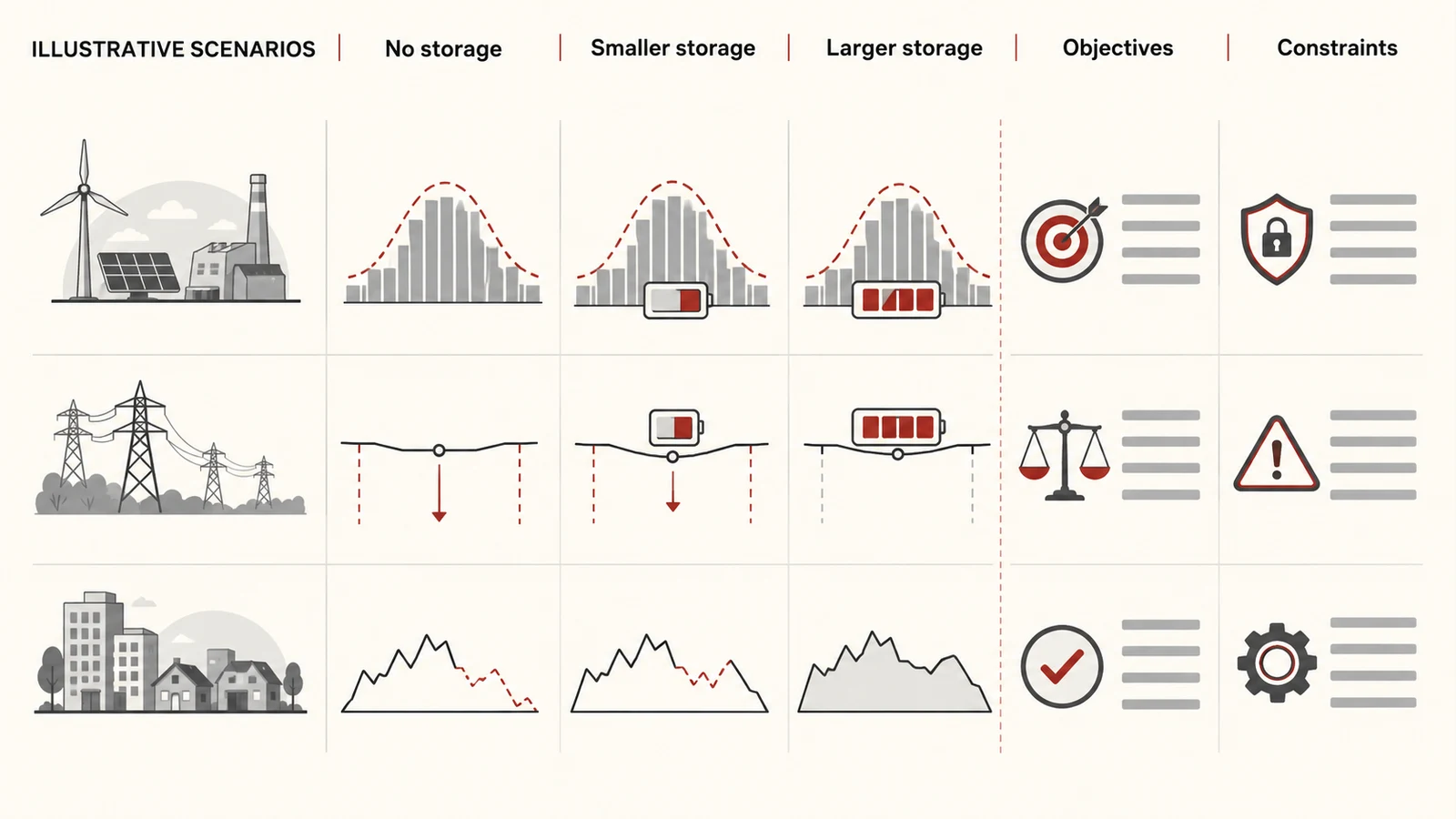
Include a baseline representing the site without the proposed change. Then compare alternatives that answer a real project question.
An illustrative assessment might examine:
- The existing site with no additional storage.
- A smaller storage option within the initial equipment constraints.
- A larger option that tests whether additional capacity changes the outcome.
- An option with a different reserve requirement for the stated resilience objective.
Keep the common assumptions consistent so the comparison remains interpretable. If both the tariff and battery size change, show that clearly rather than presenting the result as the effect of capacity alone.
Record why each alternative exists. A long list of scenarios is less useful than a smaller set tied to the decisions the team is considering.
Test assumptions that could change the decision
Sensitivity analysis examines how results respond when uncertain inputs change. Select the inputs that matter to your project, such as future load, equipment cost, operating limits, or the applicable tariff arrangement.
For a fictional warehouse planning electrified vehicle charging, the main uncertainty might be the timing and scale of the new demand. Model a documented range of load cases rather than assuming last year's consumption will continue unchanged.
Show which conclusion remains stable and which depends heavily on an uncertain input. That gives the project team a useful next action: obtain better data, revise the scope, or investigate a particular option in more detail.
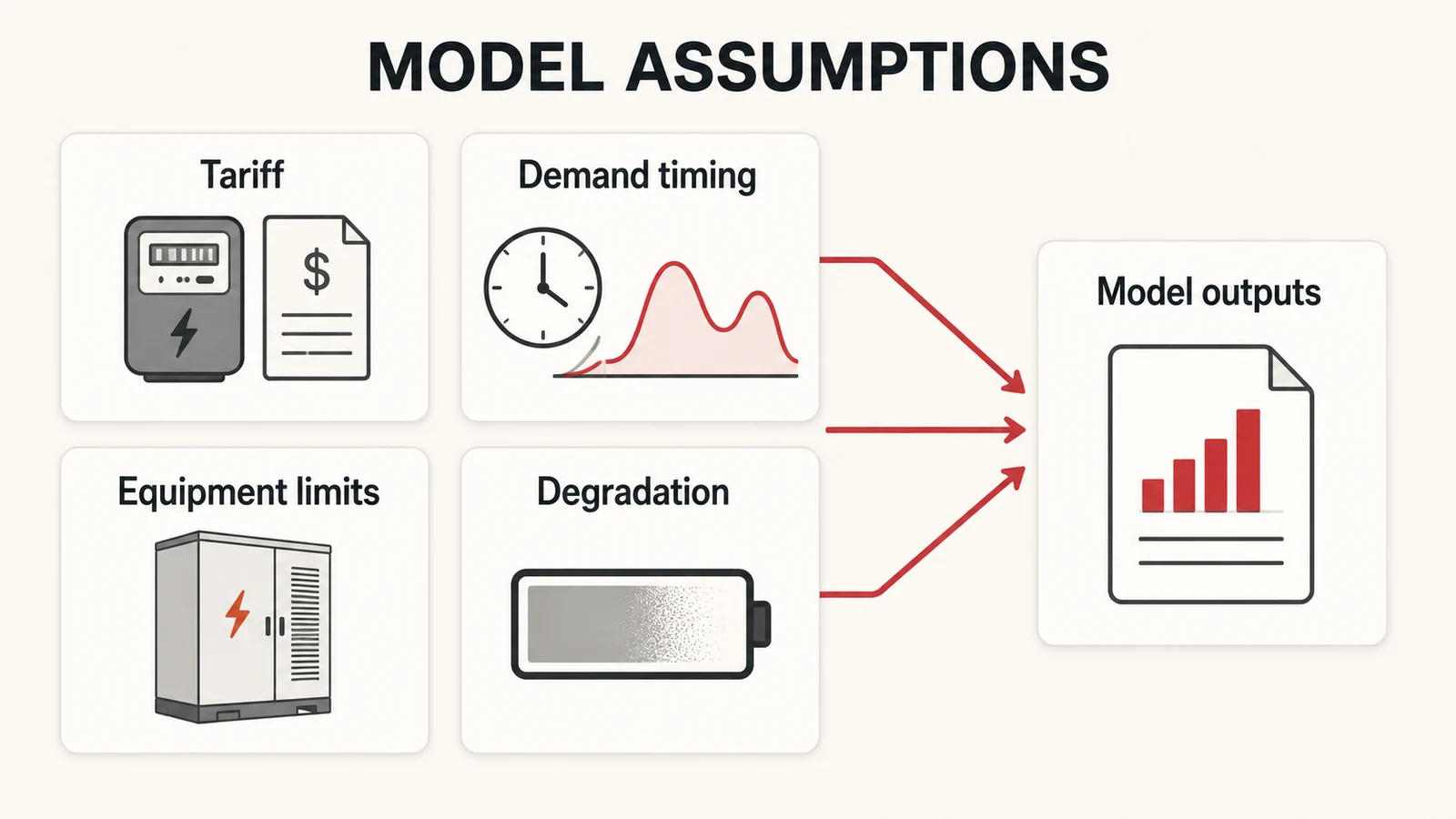
The model's estimate is conditional on its assumptions. Present the assumptions beside the result rather than hiding them in a separate technical file.
Review the outputs before using them
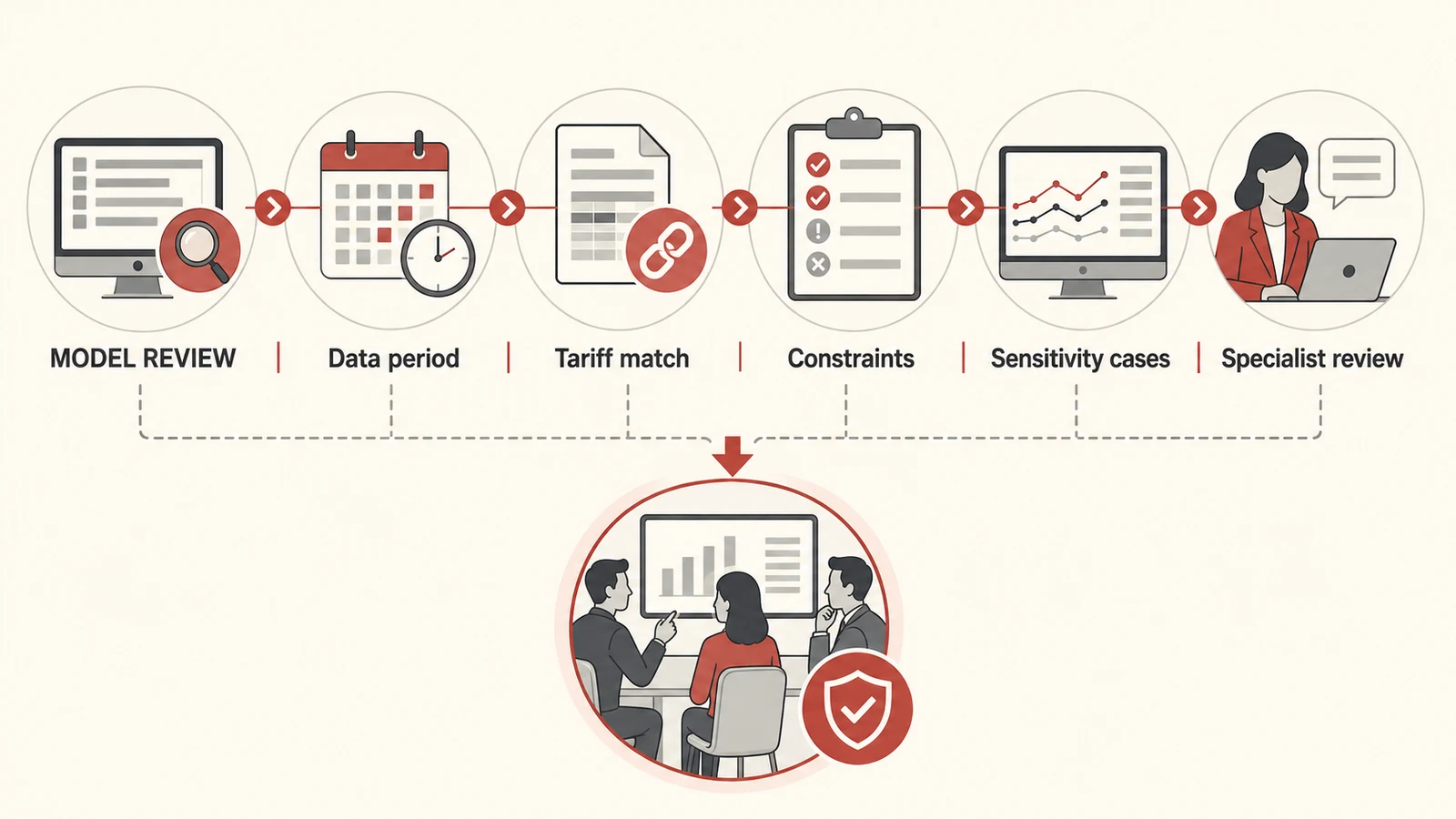
Ask a qualified reviewer to examine whether the selected model, configuration, and assumptions fit the project. Useful checks include whether the proposed equipment is commercially available, whether the operating constraints are represented, and which site-specific matters remain outside the assessment.
Keep an explicit list of exclusions and unresolved questions. These could include details requiring an engineering review, a confirmed connection arrangement, or a supplier's final specification.
Retain the model version, input set, run date, and approved output. When the project changes, the team should be able to identify which earlier result is no longer applicable.
Decide whether you need a tool or a connected workflow
An existing tool may be sufficient if an analyst can prepare the inputs and use the output directly. Integration becomes more attractive when the same work repeats across many sites or information must move between several approved systems.
For example, a project intake application could collect documents, prepare fields for review, submit approved inputs to a supported model, and assemble a report containing the result and assumptions. REopt's official API documentation describes programmatic access to its decision-support platform, illustrating one possible integration route. REopt API documentation.
Before commissioning that workflow, define who maintains the model connection, validates updates, and supports users when a run fails. Our AI readiness check can help establish whether the data and process are ready for that step.
Common questions
Is battery sizing the same as selecting a product?
No. Model outputs need to be checked against available equipment and project requirements. Product selection and detailed design require additional review.
Can AI prepare the feasibility report?
It can assist with organising documents and drafting explanations from approved results. Keep calculations, assumptions, and specialist review visible so the report remains checkable.
What should we bring to an initial software discussion?
Bring the decision you need to support, sample load and tariff information, the current assessment process, and an example of the output your team expects.
Connect assessment work to the way your team operates
Remova Tech builds applications for renewable-energy calculations and workflows. Bring the inputs and outputs you need for your storage assessment process, and we can help identify where an existing tool, an integration, or a custom interface fits.